
When looking at job announcements for Data Analytics jobs, it is easy to get the impression that a certain amount of years worth of experience with specific list of software products is all that matters.
Just like with IT jobs. But very much unlike most other jobs, actually. Who has ever heard of a job announcement for a job as a carpenter, requiring 5 years of experience using a Fiskars hammer, and 3-7 years experience with a certain model of Stanley screwdrivers?
It doesn’t happen, because it doesn’t matter. If you know how to use a hammer, you can use any hammer. Perhaps a new brand takes a few days of accustumization, but you will quickly get there, given your general knowledge of hammering, and the experience you have with other, similar, products.
“It is never the tool that decides. It’s the hands – and the heart – of the one who wields it.”
Kevin Sands
The Joyful Work With Tools
I have walked through a large number of job announcements recently, for jobs with a data analytics contents – meaning, the job title could be different, but a major part of the work as described was the analysis and visualization of data.
The announcements were mostly for jobs in Denmark and Sweden. I simply wanted to check out which tools were the most commonly used in companies in my local area, while trying to make an overview and a list on the pages here on this site, called Data, Learning Resources, and Technical Resources.
I like such lists – I like to collect them, work with them, and reach some kind of deeper understanding of what is included in the topic. In this case, the topic of data analytics in Denmark and Sweden. And I have added links to the tool vendors, as it is practical to have these links at hand when working with skill building, project establishment, etc., and the tools themselves or more information about them may be needed.
Almost all of the job descriptions told about the tools used in the department, and the required tool knowledge – often, also with a quantification of exactly how much knowledge (which apparently can be measured in years) the applicants needed to have.
Very few of them, but still some, would mention something in the line of “you have practical experience with a visualization tool like Power BI or Tableau”, and even fewer just mentioned a need for being experienced with data analytics tools.
What Matters More
What caused me to write this post now, was that I today, after looking now and then on job announcements for the last couple of months, saw the first two announcements that specified analytical skills and other similar competencies, but didn’t mention any tools.
For once, not only one company, but two companies, were ready to look at what really matters: the ability to work with data. The Data Literacy.
They asked for such things that could be indicative for them where on a scale of data literacy a candidate would be.
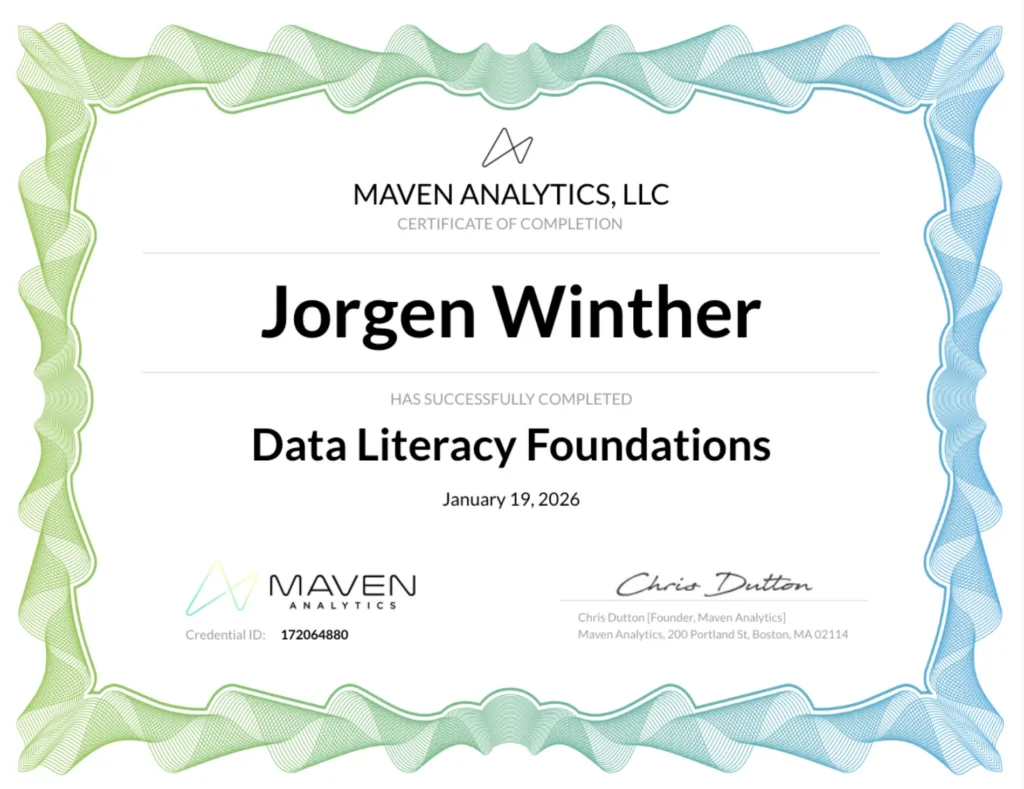
I had just completed a course in data literacy in the morning, and saw these announcements afterwards, so it felt like a strange coincidence, but nevertheless, the course, Data Literacy Foundations at Maven Analytics (actually a series of courses, a “learning path”, and I have so far just been through the first course in the series) has brought me a feeling of something being in the need to be adjusted in this business.
I suppose that wasn’t the planned or expected outcome of the course, but to me, it stood quite clear that if you try to explain what is important for a data analyst to know, then understanding data is in focus. Different aspects of it, of course, and different methods and thoughts around working with data, but still: understanding how to see data, and how to work with them, is what matters the most – not the tools.
And yet, most job announcements are full of tool descriptions and requirements.
The World of Tools
In Sweden, a large part of companies seem to use Qlik, while in Denmark, a major part of them use Power BI. Tableau still has a limited presence in Sweden, as a small number two, but otherwise, quite many different tools seem to be used for the front-end presentation of analytics, each of them just by a single or a few companies.
On the backend, I can declare Snowflake as the winner, but also Microsoft Fabric, Google BigQuery, and Databricks have their users in both countries.
In the middle, dbt is used most often for creating semantic models, preparing data, while several other tools are mentioned. However for this actual analytics layer in the tool stack, there was often nothing mentioned at all, and the same counts for the backend.
When looking out in the world to see what exists and what is being used, there really is a wealth of different products and services, and I can’t help feeling that most of these must have very few users. But, at the same time, the data analysts everywhere are likely to work on a tool stack that is quite unique, so when a company in Denmark or Sweden lists a specific stack, requiring a specific amount of experience with exactly this stack, they are ruling out just about everybody who could have applied.
Lasting and Fluctuous Needs
Data literacy is such a brilliant tool for lining up where you stand. In their Data Literacy Assessment, you can see where you stand – where on a scale can you find yourself, with the idea that even though it is beneficial for a company that everybody is on the scale in the first place, we do not all need to be on top of it. But people working with data analytics – analyzing and describing data – are more in the need to be high on the scale of data literate than those consuming the analytics results.
And that’s where I think companies should put their focus when recruiting.
When I planned the lists of tools, I was in doubt if I should even include such as Business Objects, Cognos, or the Oracle Database – which were all mandatory knowledge for anyone working with data analytics (or BI, as it was named then) just 20 years ago. Now, there’s not a single company mentioning any of these tools. And, of course, the young ones in the job market will insist that nobody needs to know about the old tools, and also – that people working with data 20 years ago know nothing of what is needed today.
But, guess what: almost everything regarding data analytics itself is exactly the same. All the ideas of how to combine data, what you can calculate, are the same. Statistics, mathematics, data knowledge in general, including how to access data through SQL, how to use a spreadsheet app (typically Excel) to work with data. It’s all the same. Management’s need for insights is about the same too.
But the tools in general have been switched. And the new tools offer some different ways of working, so that the workflow on a typical day might be different. Especially, there is less effective time needed for getting data out of the original databases, while the waiting time for getting a permission to do it is the same. And moving from a set of data into a useful set of metrics, that can be reported upon, isn’t necessarily a big job anymore – you can just do it yourself, instantly, instead of spending weeks or months with IT consultants to make them re-program the ETL loads for the data warehouse.
So, in the end, more time may be spent on ad-hoc analyses and visualization, and the turn-around time for a request to become a delivered insight, is shorter.
The end result is the same. A dashboard or a report. Now with storytelling, which wasn’t modern as a term 20 years ago, but it did happen anyway: people took your visualization, copy-pasted it into a text document, and described it there. It was always common knowledge that any illustration was valuable only with a textual description accompanying it.
And in a few years, if everything goes as always, there will be a new set of tools dominating, and again and again. The tool knowledge people were hired in on will be considered irrelevant, and everybody will hunt for skills in yet another set of tools that can make a dashboard.
Echo Thinking
Well, Maven Analytics is teaching a bunch of different things, and at a high quality level, in my experience, but the total set of tools being taught isn’t that big. They cover the most used tools, and other course providers do the same, meaning that you’ll have a hard time finding a course in less common tools such as Apache Superset or Trino, while courses in Power BI and Tableau are abundant.
I have a feeling that the current choice of tools in the companies are a result of this focus on a few tools being taught. It looks to the managers like it is the common way, or even the only way, for many companies, to use those exact tools that are mentioned everywhere, if they want to do data analytics.
Forgetting What Worked
Also, the wave of new data analysts, we saw a couple of years ago, which I talked about in another post – “Who Decides to Work With Data Analytics?” – consisted of people who went through such courses, mostly, and, hence, most companies could find people with skills in exactly Power BI, Tableau, Alteryx, and a few other tools, such as Excel, Python, and R.
It was extremely interesting to follow that wave unfold – to me, who began working with data more than 30 years ago – because back then, you needed to be some kind of computer scientist or statistician, or perhaps have some other kind of research minded education, that had required from you to work with data and make statistics and similar. Now, however, all kinds of people have become data analysts, and with good results, being happy about it and appreciated by the companies.
One of the people I followed then (and still), on LinkedIn, was Annie Nelson, who even wrote a book about her journey, “How to Become a Data Analyst”. An honest account on what she did, how it worked out, and what she felt about it, and with lots of great advice to others who want to go that way.
Now, a couple of years have passed, the wave has run out, and companies are no longer focused on taking in new people – even though it went well then, they don’t believe in it now. Instead, they require x years of experience with this and that, rather than the right mindset, as the Data Literacy model suggests.
Both Annie and many others of the new people in the business, coming from various backgrounds and, significantly, often having no prior experience with data analytics before choosing this as their new career path, are still there, doing well.
And yet, the business world seems to have forgotten that it was possible. They could hire people without several years of experience in a fixed set of tools, and still these new people could do the job and become successful. So, why can’t that be done anymore? Why suddenly, or again, this focus on tool experience?
What This All Leads To
Tools come and go. Some practical skills are directly related to the use of certain tools, so the need for those also come and go.
But, by far the biggest part of working with data is a combination of a wish to do so, having the needed patience and curiosity combined that allows you to spend time to get through the sometimes tedious tasks involved, and spending more time on trying out an idea, failing, trying something else, etc., until you get to an understanding of the data, that you can then express.
And then, some practical skills in using a set of tools for expressing it – to shape the insights into a useful output format.
The tool knowledge is the smallest part of it all. It shouldn’t be allowed to fill up a job announcement.
Personally, I enjoy when the company tells something about how they work, and which tools they use. Mostly because it indicates what kind of work environment they have. But it is much more interesting for me to see a statement like “we work together and are good at making use of the individual skills, each of us have, and take into account what each of us like to do”. Collaborative skills and mutual respect are always very valuable treats for any team.
I believe that the tool focus is a spill-over from IT job announcements, where, to be clear, the focus also could be different. The tradition from IT has been taken over by the data analytics recruitment process, because it is “something with computers”.
Just know: it isn’t. Data analytics isn’t any more about computers than business management or customer support. Yes, computers are used, they are important, but they are not the thing. Pen and paper is probably also used, and many other tools, but the main tool here is the way of thinking. That doesn’t come with any particular piece of software.
All software tools can be learned, and most often, the can be learned quite fast. They shouldn’t be the main selection criterion for data analysts.